
The young woman opened the book from the 2200s—required reading for class: U.S. Narratives in Classicide, “Transcription of Beatrice Ward”.
“Well, first off what you need to know is I was sleeping. I was sleeping, but now I’m awake.
It was 2150. There was rich and there was poor. No middle. But there were programs to provide for we folks in the lows. We got an allowance for food each month. Certain stores, certain foods; mostly boxed meals—heat-and-serve, so it was real easy.
Everyone in my county was obese. Many had diabetes—whatever that was. We were told, then prescribed. Then one day, out of the blue, the government doctor said, “We suggest you replace table sugar with honey. It will be replacing sugar in all our standard market recipes immediately, but we are strongly recommending the shift at home as well.”
Now, honey wasn’t anything just anyone could buy. That’s a pricey extra and if folks don’t know what it tastes like they don’t go working extra for it. I guess that doctor saw it on my face. There were programs supporting it, he said. New research said that honey, could expose folks to a variety of pollens which could reduce allergy symptoms—a rising killer at the time. There were special quantities set aside for specific counties and mine was one. We had an elevated allergy death rate, he said, which I didn’t know. Can’t read the news if you can’t read. You can only watch or listen, so back then it’s what the Highs share, what the Highs want to know. I could tell you back then no High gave a damn about some allergy deaths out in the lows. Now? Now I know.
I brought the honey home. The doctor said it would just take time—the body was getting used to new allergens. Visit after visit I was told I was progressing as expected; that the rashes and headaches were fairly common; trouble breathing was “mild asthma”. I kept taking the honey. Then nausea and fatigue. “Just as suspected,” the doctor said. “You’re right where we want you to be. You’re peaking. The next phase is simply no more allergies.” And you bet I was looking forward to that. He gave me a larger bottle that appointment. Told me to finish that before next month’s visit and that would accelerate my getting over the peak.
There were groups of Highs just forming then. Highs with a sense of how low they had gone and a guilt for how many they had put in the ground. They found me in my hospital bed, dying of complications with colitis.
It was the honey. The meals. Mass murder—classicide of the lows. We dropped like flies. A massive nation-wide yearly order of imported government-issued honey was determined on arrival to be contaminated with chloramphenicol—an antibiotic used to keep the bee population healthy but possibly fatal to people consuming it unknowingly, reactive to several basic over-the-counter drugs. The High executive that ordered the shipment was secretly executed, but so was the order to feed that shipment to the lows; to use it in our issued meals while reordering smaller amounts of the pure stuff for the Highs. Such a large and expensive order could not go to waste.
When you think of it, it’s kind of funny how so much effort can be taken to keep money-making insects healthy—while willingly using its product to sicken and kill the poor unable to give to the rich.”
###
This story was inspired by the Netflix docuseries, Rotten, episodes “Lawyers, Guns and Honey”, and “The Peanut Problem”.
My mind likes to leap off of fact and into the world of fiction; the land of what ifs, and where few ideas can really go “too far”. So, we lept, but only a little bit.
Watch the episodes. Interesting stuff!
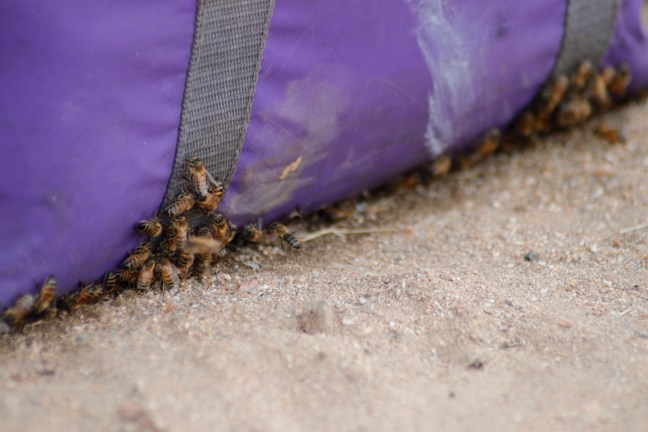
My mind has been on bees since I was stung by one a couple of months ago. It was fierce sting and reminded me of the power of even the tiniest in nature. A couple weeks after having been stung, I went camping in the desert where I took the photo accompanying this story. The bees came one-by-one, first to a 5-gallon water jug, then to the condensation on an insulated cooler bag.
We’ll all do almost anything to survive. The thing is, survival looks different to every single one of us. For some, it’s just the simple things like water, food and a community; for others, survival is complex and “requires” the acquisition of many things. I tried to also touch on that in this piece. Not sure if it came across. What do you think?
 the RAMBLE